
CLIENT BACKGROUND
An experienced DCU operator reassembled existing BUD valves after an overhaul during a critical turnaround event. Persistent joint leakage had historically affected performance, prompting a gasket redesign from IES and the implementation of RT-Bolts for improved assembly accuracy. The unit featured four drums, each with a single-side entry feed, requiring precise assembly to ensure operational reliability.
CHALLENGES
Historically, the BUD joint experienced persistent leakage, which was a significant operational concern. Upon disassembly of the BUD valve, "gasket walk" was observed—this refers to the deformation of the 316 SS gasket in the radial direction, causing it to shift or lose its proper seating. This deformation compromised joint integrity leading to leakage.
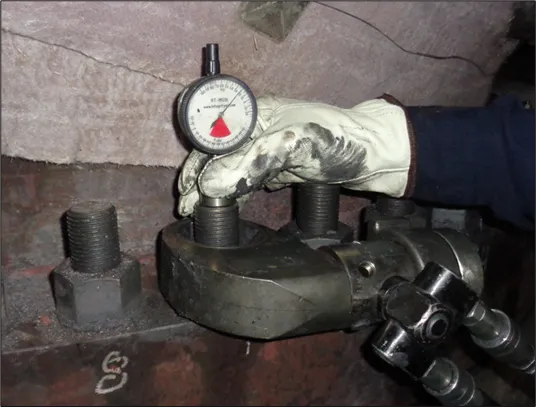
Bud valve torquing with RT-Bolt gauge,
SOLUTION
An Increased gasket diameter including an outer ring incorporating bolt holes to constrain gasket. Gasket material switched to Inconel 625. A full set of RT-Bolts were installed to ensure accurate assembly. Joint was initially hydraulically tensioned (50% coverage), The RT-Bolts identified that the residual bolt load achieved with hydraulic tensioning was about ~50% of the target. Hydraulic torque was utilized to further tighten all studs to achieve the target bolt stress. Post cycle re-tightening was successful with RT-Bolts indicating a 30% reduction in bolt stress (expected) prior to re-tightening after the coke was cut. The K-Factor of the anti-seize can change with temperature, using RT-Bolt allows selection of the correct torque figure to be obtained directly during assembly.
CONCLUSION
No further re-tightening needed – Joints operated reliably for 340+ cycles, with Zero leaks.
Initial hydraulic tensioning was not fully successful, reaching only 50% target bolt stress – RT-Bolts revealed variations in the bolt stress levels.
The suggested gasket redesign eliminated gasket movement during service.
RT-Bolts ensured correct bolt stress – Direct readings eliminated reliance on torque-based K Factor, which can vary with temperature
CASE STUDY

